November 11th, 2011
FB Fan Appreciation Day
One of my favorite things about designing stencils to share with the world is getting to see how our customers use them in their homes and creative projects. All this internet interconnection makes it even easier to enjoy these rewards-and to share them with others. I truly love and appreciate it when people “share” their stencil art on our Facebook Page. It’s like instant gratification on steroids! This past week there were some particularly NICE photos posted, so just in case you missed them, here’s a visual recap…
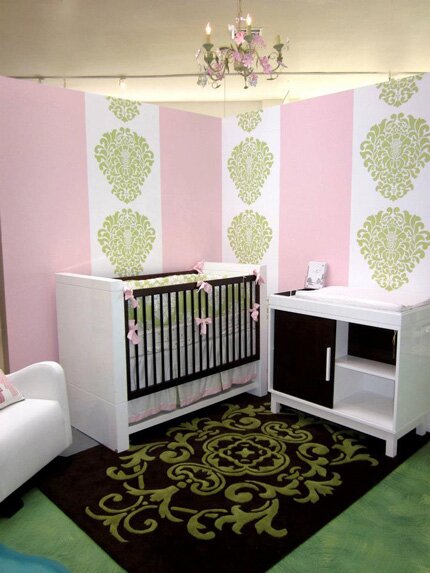
Nichole Blackburn of Celadon Style recently completed a large commission at Bel Bambini, a high-end baby boutique in Newport Beach, CA. Nichole completed 20 different original and creative murals and decorative schemes throughout the store to coordinate with different nursery collections. Here, she used our Grand Damask stencil in a stripe pattern to create a romantic graphic look.
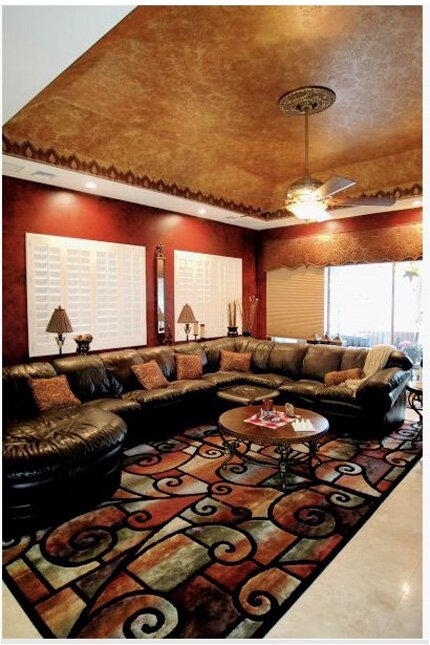
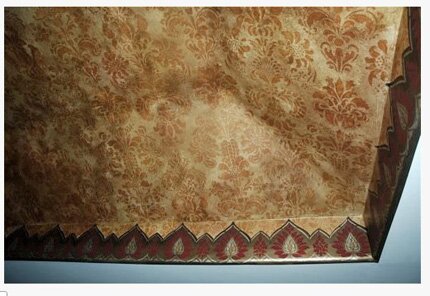
Former textile artist turned decorative painter and muralist extraordinaire, Carmen Benoit, is always to nice to comment on our Facebook pages and posts, so I’m thrilled to share some of her lovely work on a grand ceiling. Carmen used our Delicate Floral Damask all over this tray ceiling and finished it off beautifully with the Oriental Brocade Frieze border pattern. This looks like SO much work, but what a STUNNING effect!
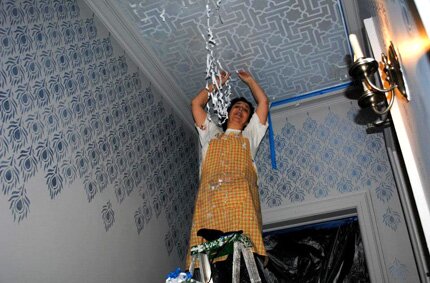
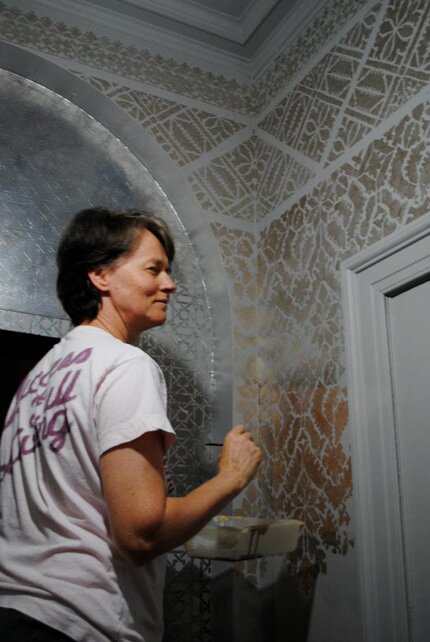
Sylvie Bilger of Metamorfaux (top photo) is an amazing person and artistic talent who I met recently on our last Moroccan painting adventure to Peacock Pavilions. She was such a joy to be with and I am thrilled to be sponsoring Sylvie’s space at the upcoming Holiday House NYC event to benefit the Susan G. Komen foundation for breast cancer research. Sylvie is very modest, so she probably won’t tell you that she trained at an important decorative finishing academy in Europe and her first job had her working at the Palace of Versailles, but I think that deserves a major SHOUT OUT! Sylvie is currently completing two amazing hall spaces in the showcase house with a combination of stencils and Modello patterns pulled from our Moroccan stencil collection.
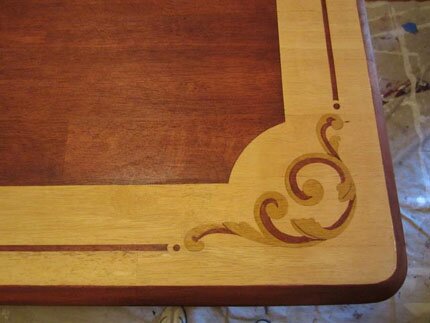
On a much smaller scale, artist Kathryn Donatelli shared a table top that she enhanced with wood stains and one of the designs from our Architectural Scroll Set.
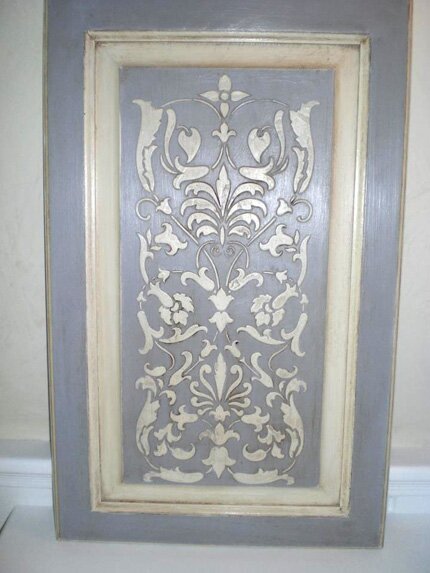
Another fellow Moroccan traveler, Cindi Rowley of Cindy Rowley Designs recently shared a cabinet furniture finish using Annie Sloan Chalk Paint and our Ornate Italian Panel stencil. Cindi embossed the pattern for a raised effect which is highlighted by the lovely antiqued wax finish.
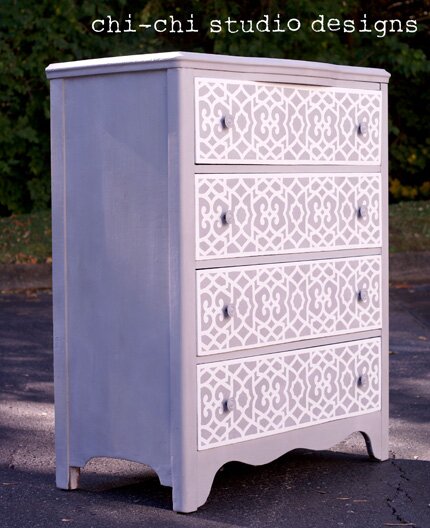
Another Chalk Paint furniture stencil project was posted by Kristin at Chi Chi Studio Designs. This is a super pretty blog by a darling Mississippi girl and this dresser stenciled with Paris Gray and Pure White and our Small Chez Sheik Moroccan stencil totally rocks, IMHO! Oh, and by the way, Royal Design Studio is now officially the stockist for Annie Sloan Chalk Paint in San Diego County, but I haven’t officially announced it yet, as I am trying to get all my ASCP ducks brushes in a row.
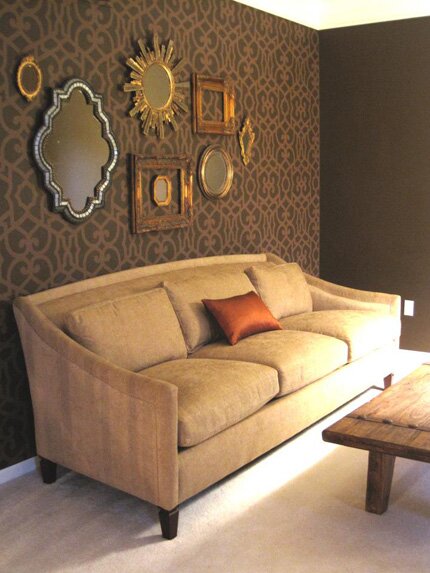
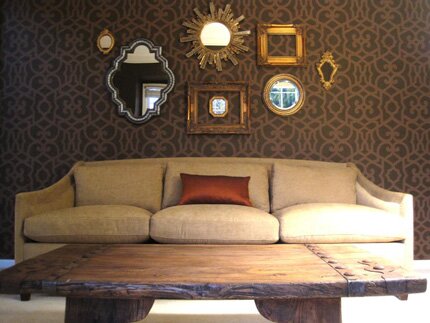
And now for the BIG finish!! It’s the Chez Sheik Moroccan stencil again-this time in the larger version. When I saw these pictures posted on our Facebook Page wall today by Haneen Matt, I thought they were the work of a pro decorative painter. I was already SUPER impressed by the color choice and stylish props, but then I found out that she is a very talented homeowner and I was super, DUPER impressed. How about you??
So-there you have the week in review, and now you know how much I LOVE it when peeps share their stencil photos…….so…….I’m just suggesting……and letting you know that our Facebook page is right here. Have a lovely, creative weekend!
September 24th, 2011
Stencil Freshen Up 2
A couple of weeks ago, I shared some fresh new stenciled looks with some of our classic stencils. I have some more great updated stencil looks to show you today. Hopefully it will spark some ideas and get those creative wheels turning!
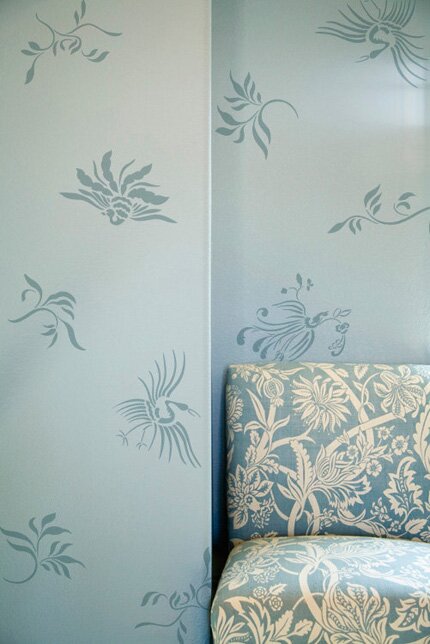
The Oriental Brushstroke Chinese stencil is a series of individual fanciful bird and leaf elements that you can scatter at will over a wall to create a loose, painterly wallpaper effect. Here, it looks very soft in shades of blue, but you can use it in metallic colors over dark backgrounds for very dramatic effects too!
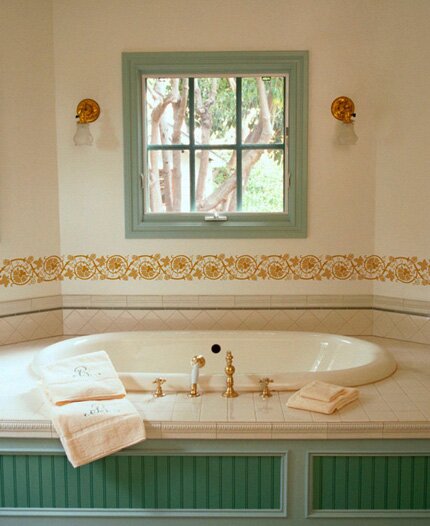
A border stencil can be perfect for adding just the right touch of color and design to spark up a plain wall. The Elegancia Border stencil is shown here above a step-in tub. Notice how the gold color ties in with the bath fixture and really warms up the wall. Simple, but effective. If you wanted to add more pattern, this design coordinates with our Elegancia Allover stencil.
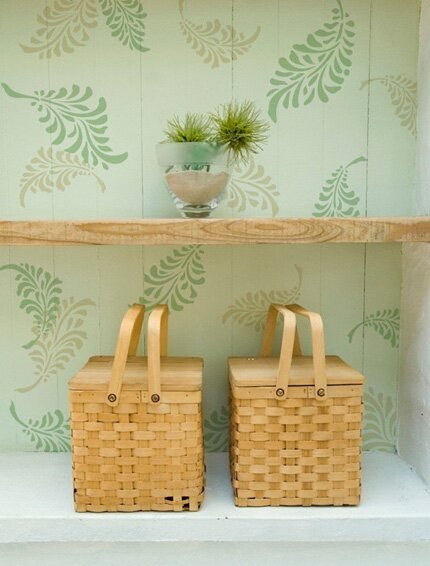
Another area to try a wallpaper effect with stencils in on the back wall of an open bookshelf or china cabinet. Here, the Falling Feather stencil is perfect for creating a casual, yet custom effect. This is another fun stencil for scattering across a wall, but would be great on a floor, furniture, or fabric project as well.
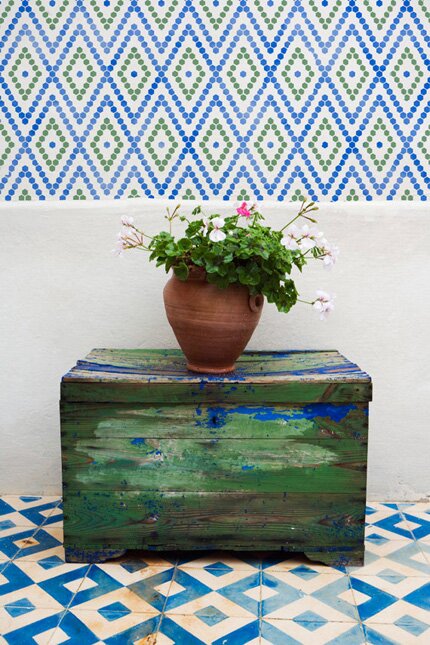
The Moroccan Hexagons border stencil can also be repeated to create an allover pattern, as shown here. This pattern is perfect for an entry hall or bathroom wall. Using stencil brushes makes it easy to paint the tile pattern in multiple colors.
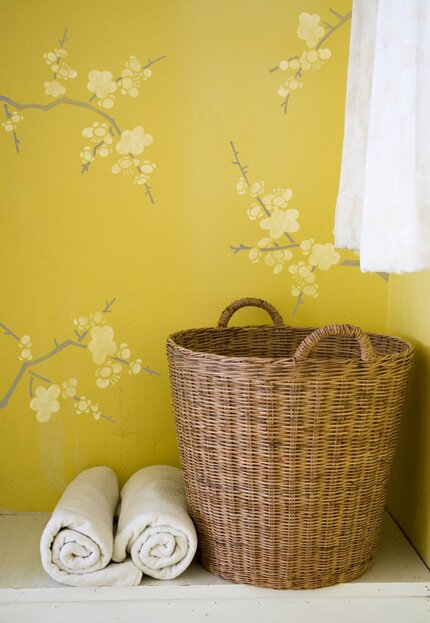
Our classic Japanese Cherry Blossom stencil set takes on a fresh, modern vibe in a yellow/gray/cream color scheme. Individual branches are fun to scatter and stencil. Shown in a laundry room setting this design works great in bathrooms, bedrooms, even nurseries!
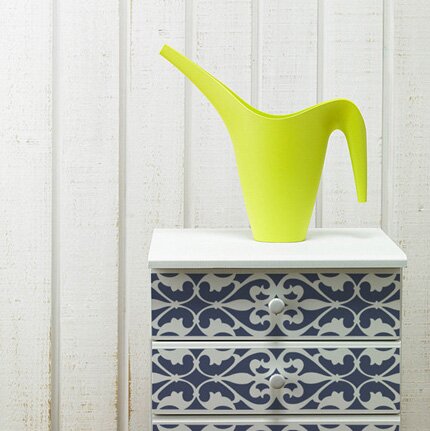
One of our most classic and popular designs for many years, the Florentine Grille Border stencil comes in three sizes, so you can use it for everything from a ceiling freize to a small furniture stenciling detail. Here the medium size is shown centered and stenciled on drawer fronts in boldly contrasting colors for a clean, contemporary look.
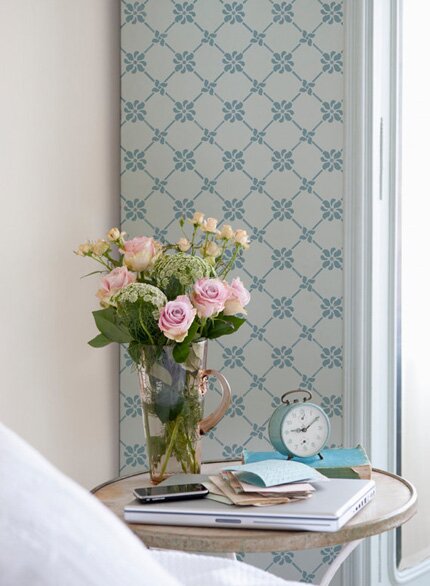
Another pattern that is available in multiple sizes is the allover Victorian Grillwork stencil. This classic floral trellis is perfect for furniture stenciling. The larger version is shown here stenciled on the side of an armoire. It’s a perfect romantic look-yet not too fussy!
I hope you enjoyed this stencil re-fresher. Perhaps you have some older stencil patterns laying around and maybe now are inspired to try them anew in some updated colors. That’s what is so great about stencils! They can take on a whole new attitude with simple changes in color and application. Happy Painting!
September 12th, 2011
Fabric Stenciling:Pillows
Fabric stenciling is an easy, fast, and fun way to create some custom patterned projects around your home. I recently shared a great stenciled Roman shade project that Jen at Tatertots and Jello did with our Chain Link stencil in this post. Jen does some really lovely DIY projects and I was thrilled to see her latest stencil project post using Royal Design Stencils on fabric napkins from Target to create some chic, coordinated pillows for her kitchen banquette.
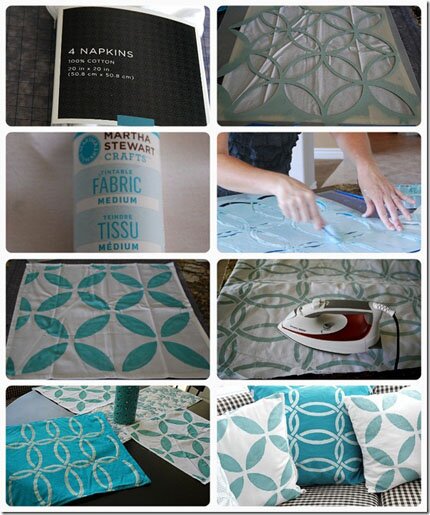
Jen used our Chain Link stencil again, and this time paired it with the Endless Circle Lattice stencil. Martha Stewart has recently added her name to a line of new decorative painting products from Plaid, which Jen also used, though any fabric paint would suffice. Gotta love Martha…..
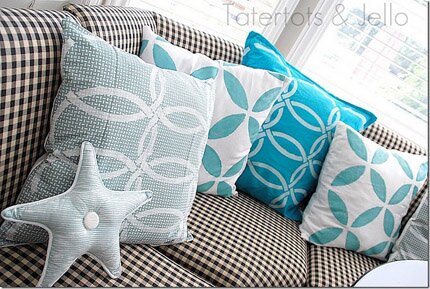
Look how adorable these pillows look on the black checked fabric! Thanks Jen, for yet another inspiring project! We are enjoying your new stencil addiction!! 
September 7th, 2011
Stencil Freshen Up 1
Well, summer has come and gone (OH SO quickly!) once again. The kids are back in school and this is traditionally the time of year when lots of people’s thoughts turn to home decorating projects. After all, the holidays are approaching and fall is a great time to freshen things up a bit! We have some freshening up projects going on around here-Royal Design Studio and Modello Designs website redesigns to be exact. Even this pretty but aging blog. It’s a ridiculous amount of work, but going to be SO worth it…..someday…..soon…..I hope. So, I’ve been doing some housekeeping at Royal Design Studio. Trying to figure out which stencil patterns to “let go” and which to keep. I’ve been selling some of these stencils since the mid 90′s and some of the color and finish representations are looking a bit, well, dated. But just like that old piece of boring brown but highly functional furniture, many of these stencil designs have stood the test of time and could continue to do so if they just had a fresh coat of paint and some perkier colors added. And so, here you go! Some refreshed classic stencil patterns from Royal Design Studio….
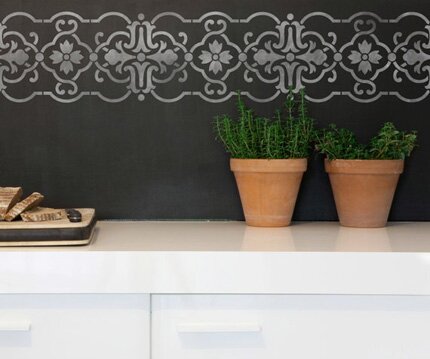
Our Granada Border Stencil looks very cool and current stenciled in white as a backsplash pattern over a chalkboard paint finish.
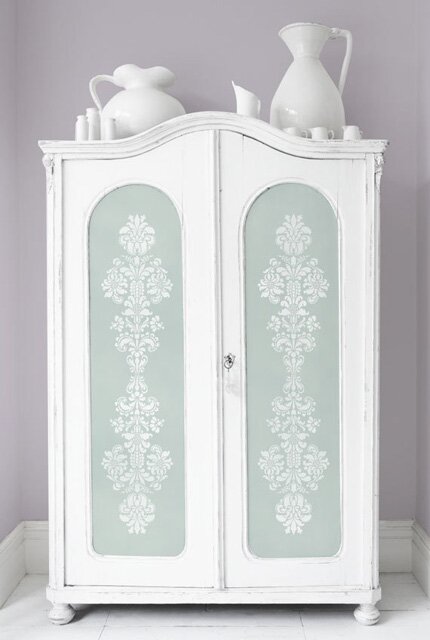
The Delicate Floral Panel stencil pattern is generally used as a wall stencil, but it also makes a great furniture stencil when used in the panels of a large armoire.
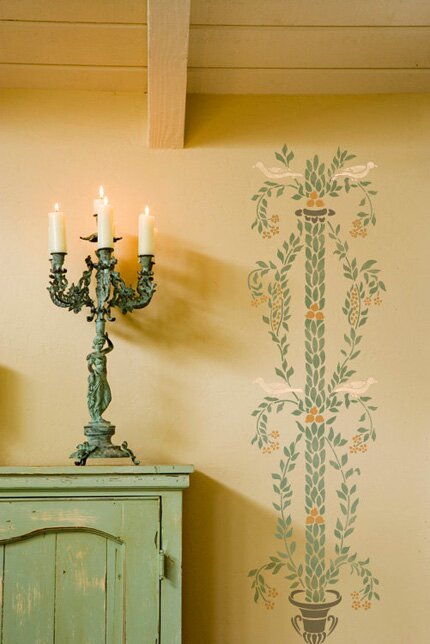
We have a small series of stencils inspired by the tragically romantic ruins of Pompeii. This Botanical Column Stencil , with its delicate vines and birds works equally well in other romantic settings. This wall stencil repeats vertically and can be used as a single element of wall decor or repeated around a room for a patterned stripe effect.
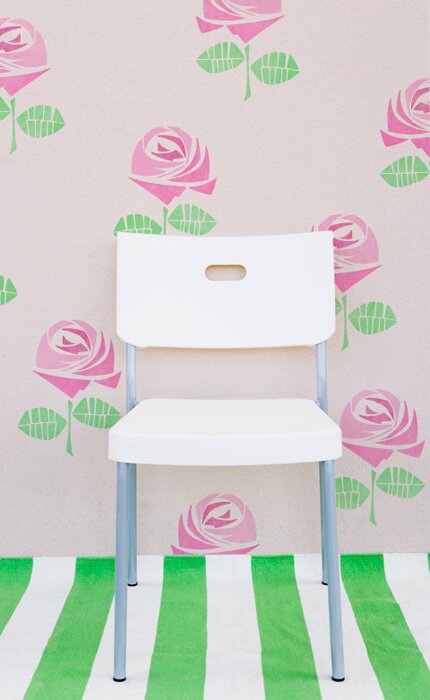
Our Large Rosie motif stencil has an chic, Art Deco look. It’s adorable for nurseries or children’s room, especially when stenciled in shades of lipstick pink!
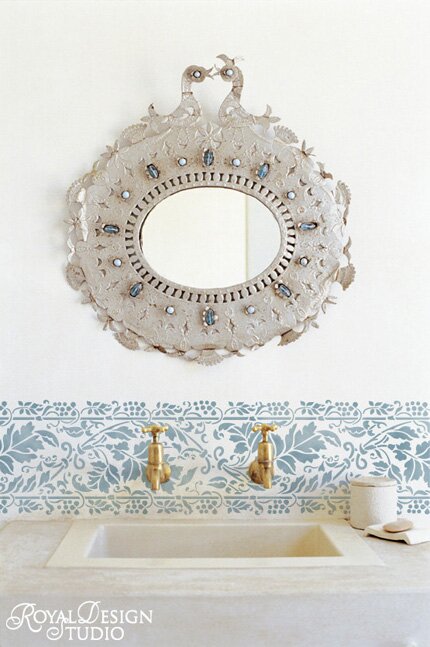
The Brocade Border Stencil has been one of my favorite stencil patterns for years. I love the delicate vine and berries. It has an Indian vibe to it, especially when paired with a punched tin mirror.
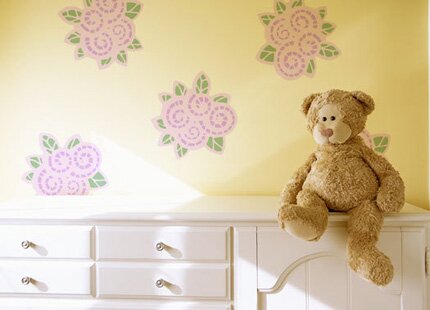
Another funky floral stencil pattern that works great for nurseries and little girl’s rooms is the Deco Doily stencil from our Modern Options Stencil collection. This two layer stencil allows you to introduce a coordinating color for the background which really sets it off from the wall color.
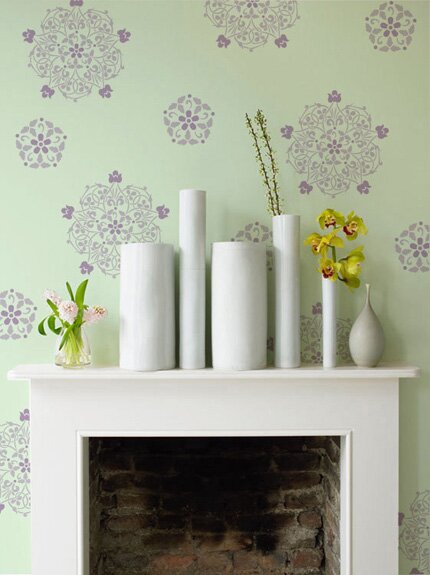
The Floral Medallions stencil set is based on ancient Middle Eastern patterns, but it looks cool, fresh and contemporary in minty green and lilac colors. It’s very quick and easy to scatter stencil motifs like this around a room for a custom wallpaper effect.
The great thing about stencils is that you can completely change the look and feel of the designs simply by changing the colors. So, do you have some freshening up projects planned for this fall?
September 1st, 2011
Indigo Stencil Inspiration
Well, it is just one month away today that my 4th and next Peacock Painting trip begins to lovely Peacock Pavilions in Marrakesh, Morocco. We have a fabulous group going but there is still space and time available if you’d like to join us on October 1-11! You can find more trip and itinerary details here.
I’ve written about these trips about a million times, so you may know that I coordinate these painting adventures with the super chic and creative Maryam from My Marrakesh. Maryam has no limits to offering up great spaces to decorate with paint, or exotic inspiration to draw from. On past trips we’ve applied all sorts of inspired decoration to varying surfaces throughout Peacock Pavilions-a boutique hotel and retreat site just outside of Marrakesh.
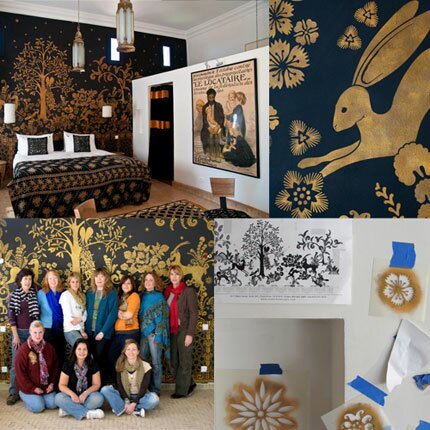
There was an Art Deco Mural inspired by Rateau,
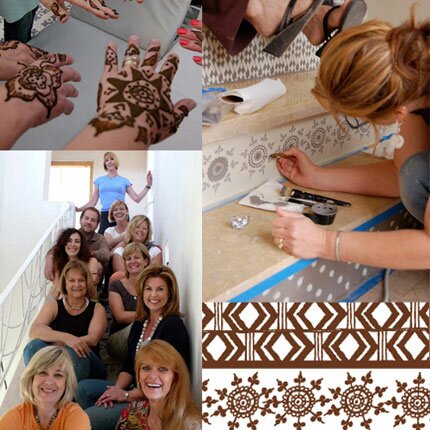
stair risers based on henna patterns,

ceiling patterns taken from inlaid camel bone furniture
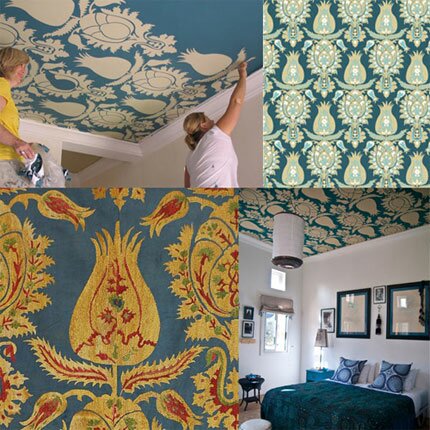
and antique suzani fabrics. We’ve done lovely lace and typography floors,
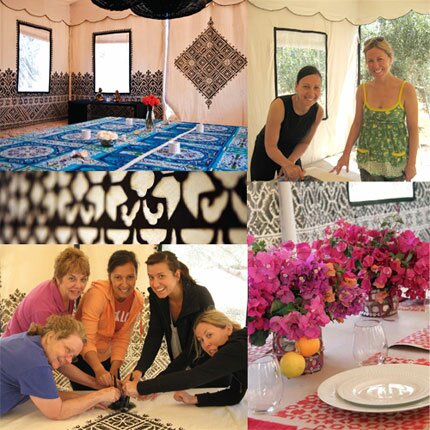
and even an entertainment tent stenciled with Fez embroidery inspired patterns.

We have several projects planned for this next trip, the largest which will be another stenciled concrete floor with the look of patterned indigo fabric. The floor will be the base of a new, open air tent created for outdoor yoga practice and more.
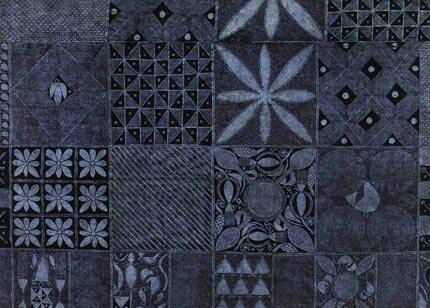
As I begin to work on the designs, I thought I would share some of the inspiration I am working from: Nigerian resist-dyed indigo.
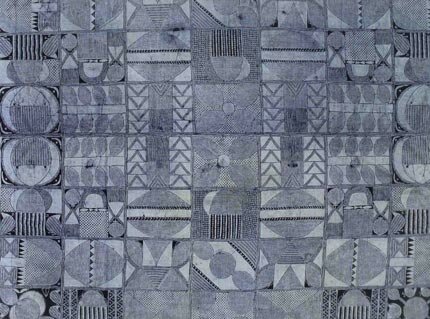
Resist techniques such as tie-dye, folded and stitched resist, wax batik and starch resist are common methods of surface decoration throughout the West African region, and the Yoruba of Nigeria are masters of the indigo-dying process. The two examples above are done with a starch-resist method, where the cloth is carefully folded and the intricate patterns hand drawn using starch made from cassava flour and sharpened quill from a large bird.

Stitched resist patterned are achieved also by folding the fabric, but raffia is used here to stitch the patterns into the cloth. When dipped,these areas resist the indigo dye, which is infused over multiple layers to achieve the rich inky blue/black color. The level of detail and intricate quality of this work is quite humbling for me as I attempt to interpret these into easily usable stencil designs! I am really looking forward to this, though, as I think that the concrete stained and painted floor that we create will be AMAZING!
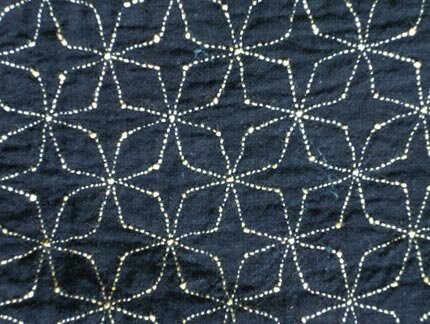
Serendipitously, I just happened to stumble across this post on Indigo on a lovely blog called This is Love Forever, by super stylist Kayte Terry which featured the above fabric sample. One of the previous Peacock Painting trips caused me to design a whole collection of Moroccan stencils based on zelij tile patterns and this is one that we have called Large Moroccan Inlay. I think that doing this pattern in random sized dots would be be brilliant and pondering if this could be replicated on dark denim fabric using a bleach pen?!?! Hmmmm.
Just have to say it one more time guys….if you are interested in going on an amazing journey to Morocco with us, you can find more trip and itinerary details here. 
August 30th, 2011
Stencil Wall-ternatives 2
Continuing a theme from last week, I have a few more Stencil Wall-ternatives to share today!
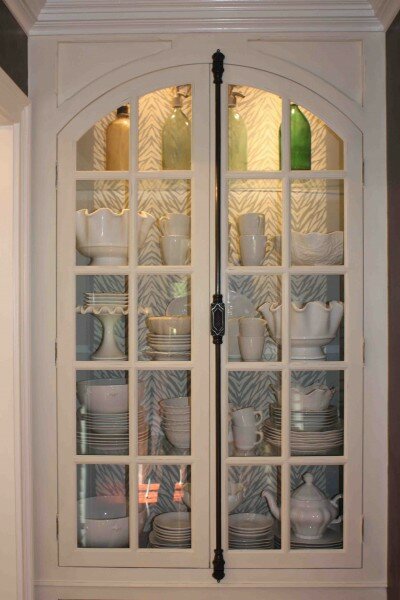
Amy from Playing Sublimely is lucky enough to have a skilled carpenter husband! Who’s NOT jealous of that?! He created a custom built-in cabinet at the end of a hallway which Amy promptly painted with Annie Sloan Chalk Paint.
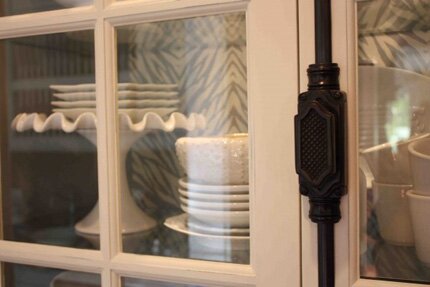
Not happy with her first try, she tried, tried again, this time opting for a more classic paint treatment and the decidedly “un”classic and ultimately COOL look of stenciling our Zebra Stripe stencil pattern on the back to show off her pretty white dishes. Check out this post also by Amy to see some more Royal Design Studio stencils used on her walls. I’m sure you’ll find her home dreamy and inspirational-especially if you like formal, classic design.
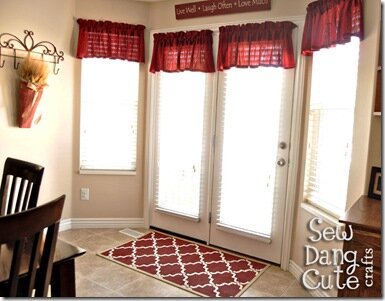
Back to the floor, here is another fun stenciled sisal rug project from Tam at Sew Dang Cute. A project like this is super fast, easy, and economical. Sometimes it’s the little details that add so much!
Royal Design Studio and Modello Designs customer Terry Leibenguth recently sent in some photos of a stenciled ceiling project that I just love! This one features our ever lovely Allover Flourish stencil on the ceiing of a powder bath.
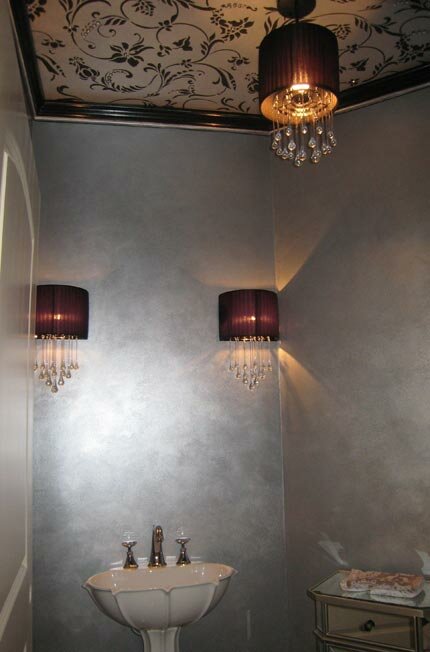
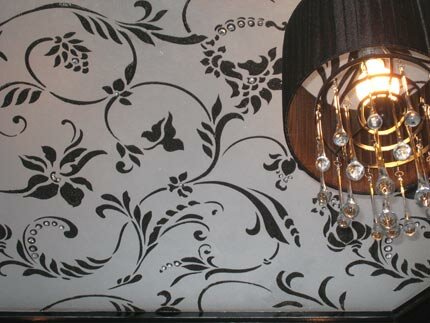
Check out the added bling Terry added with glitter and crystals.
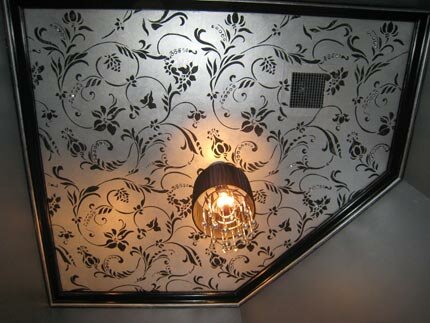
Crystal embellishments to stenciling has become increasingly popular, and I think that Terry added just the right amount to accent the stencil pattern and tie it in to the lovely light fixtures.
We love to share our customer’s stencil projects. They inspire us and hopefully inspire you too! If you have a stencil project yould like to share and share alike, please send appropriate photos to .
August 24th, 2011
Stencil Wall-ternatives 1
Stenciling walls with allover patterns to create a wallpaper effect is “all the rage” this season, and all I can say about that is……YEAH! I started creating damask-inspired allover stencils for Royal Design Studio back in the last century (gulp!) and it’s great to still be seeing both our classic and modern stencil designs being put to good use all over the web these days. Stencils, of course, are the ultimate decorating tool for adding personalized pattern to MANY different surfaces, though, and I’m super thrilled to be able to share some wall-ternative ideas with you here. It’s very rewarding to see our creative blogging friends mixing it up with these fab how-to-stencil projects. Even greater is how they take care to share with their readers how to achieve these looks. Case(s) in point:
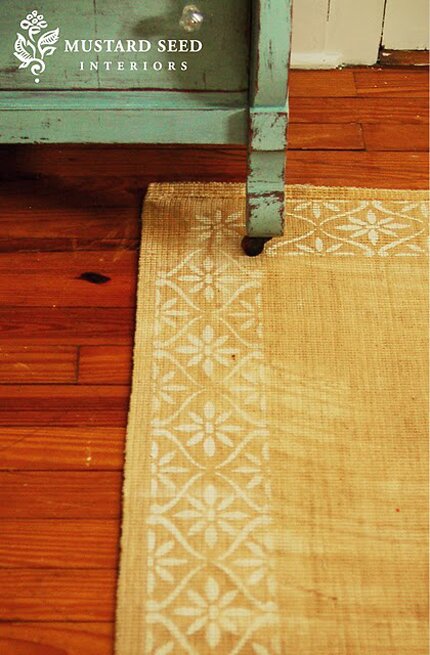
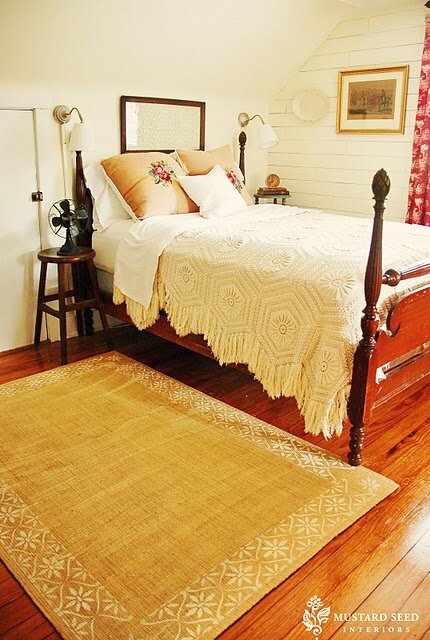
This sisal rug stenciling post by uber-talented Marian on Miss Mustard Seed. She used our sweet and simple Daisy Chain border stencil on the BACK of an inexpensive rug.
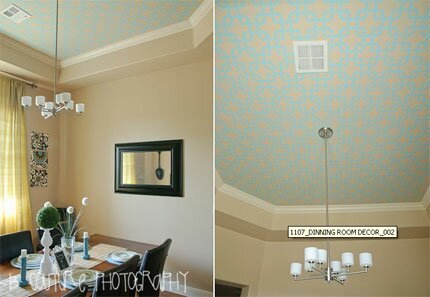
Stenciling on a ceiling is a great wall-ternative! Yes, yes, it’s a bit more challenging when you have your hands over head, BUT the end results are dramatic, unexpected, and amazing! Chelsy shares her and her hubby’s adventures in how to stencil a ceiling on B Couture Photography using our modern Linked In stencil.
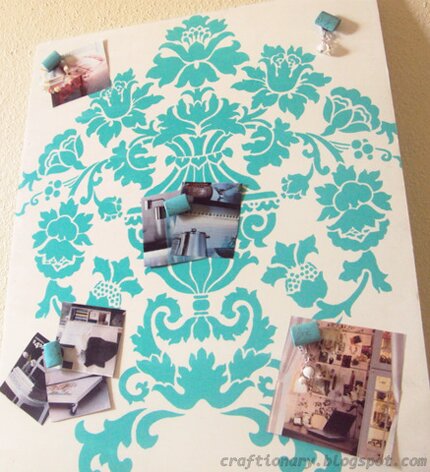
Interested in a smaller project perhaps? Hani at Craftionary shares how to make a stenciled magnetic photo board with our lovely Encantada Damask stencil.
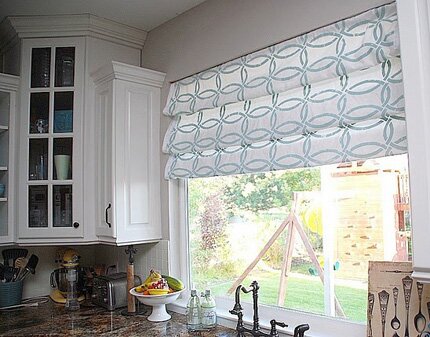
Have you noticed how custom window treatments are SO expensive? Have you ever thought of stenciling your own inexpensive fabric and creating a completely custom treatment? Yeah, me neither, but check out this easy stenciled faux Roman Shade by Jennifer at Tatertots and Jello (cutest blog name award!) using our Chain Link stencil pattern, and you WILL be inspired!
Would you like to see MORE wall-ternatives? Just so happens I have a few more up my sleeve for the next post….:)
July 14th, 2011
Better Homes Stencil Blessing
Whoa! Wait!! It’s THURSDAY already?! Did anyone else just blink and find the week almost gone??? I was meaning to post this on Monday (well, longer than that actually) because this is something kind of BIG!
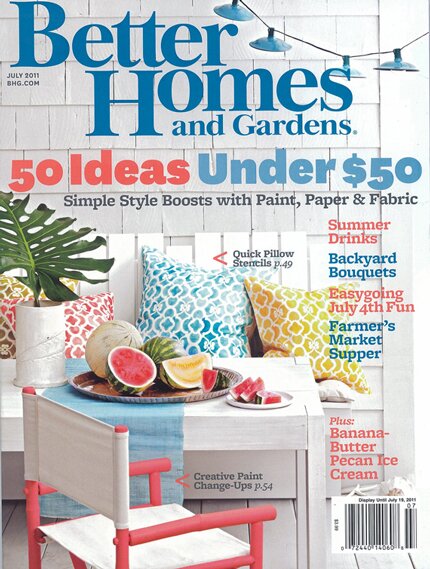
A few months ago, we received a request for a bunch of stencils from our Moroccan stencil collection from Better Homes and Gardens for a possible feature in their July issue. They had actually chosen stencils to use from another company already (not sure which one), but when they saw ours they decided to make a switcheroo. They “hinted” at a possible cover shot, but couldn’t say for sure, and we waiting patiently with fingers drumming….
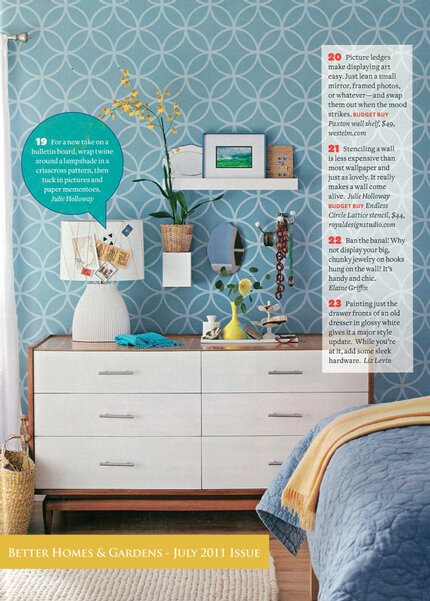
You can imagine how THRILLED we were to see our Small Chez Ali stencil used on multiple pillows on the cover, as well as some great interior shots! You can imagine that we are cutting a LOT of Endless Circle Lattice stencils these days with this beautiful blue wall stencil application to showcase it!
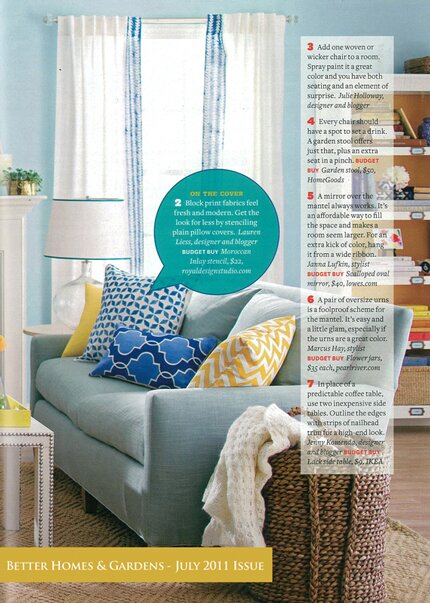
There is even more great stenciling shown on another page where they used our Moroccan Inlay stencil on even more stenciled pillows, and the darling Chicken Stitch stencil on some curtains. As you would expect from Better Homes and Gardens, they did a fabulous jot with the styling and photography, and we are so appreciative to see our stencils put to such gorgeous use!
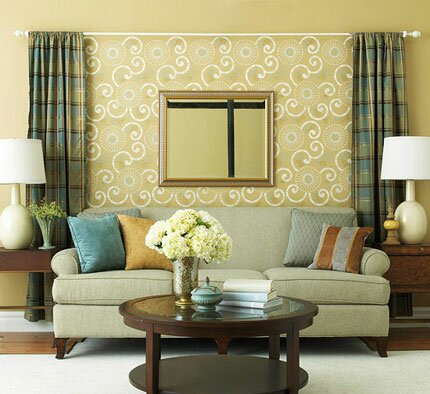
More stencil excitement! Just yesterday, a friend turned my on to this “Decorating Rules You Can Break” feature on the Better Homes and Gardens website that shows our Japanese Kyoto stencil cleverly used as a feature panel between two curtains on a wall. How cool is this! A lot of times you don’t necessarily want to stencil an allover pattern “allover” and the coordinating curtains provide a nice frame. I could totally see this idea working on a bed wall, with the stencil pattern acting as a “headboard” that is softly framed by the fabric!
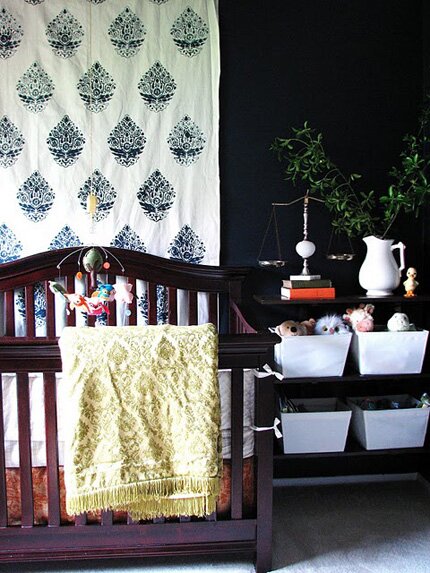
But wait! There’s even MORE to this stencil tale!! One of the bloggers featured in the July Better Homes and Gardens article is the talented designer, Lauren Liess of PureStyleHome. While I was enjoying perusing her delightful blog yesterday, I stumbled upon a great stencil project that she did for her nursery.
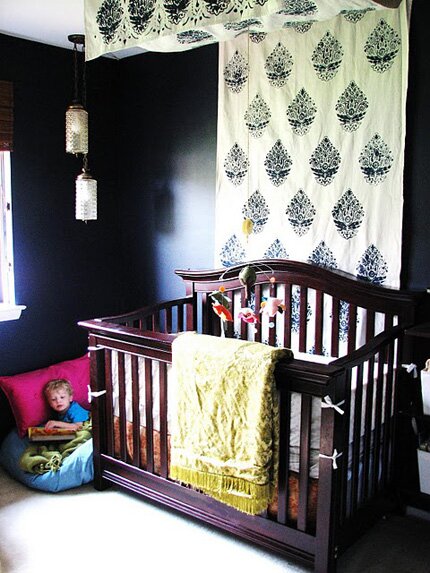
This clever canopy is actually a canvas dropcloth that she stenciled with our Small Indian Paisley stencil motif in a repeat pattern to create a damask effect. Notice how she repeated the same motif on the front drop of the canopy to create a stenciled border. Simply. Brilliant!
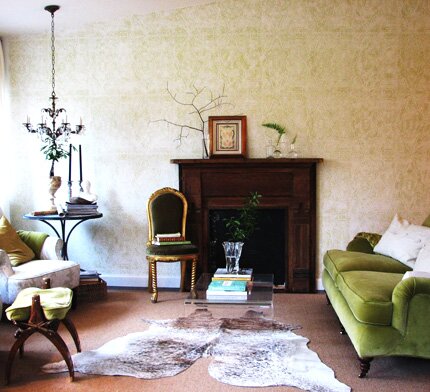
Lauren has some other smashing stenciling in her home, via a classic Ralph Lauren stencil pattern.
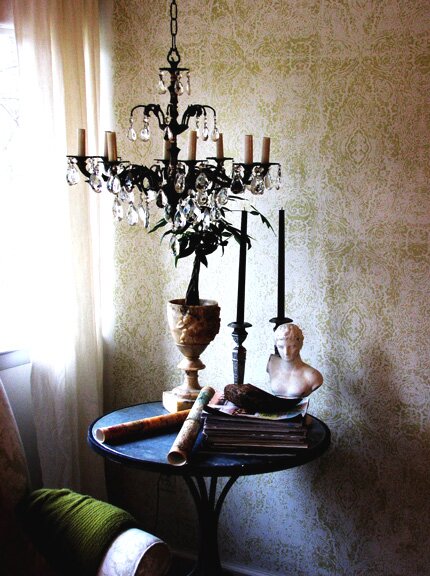
Isn’t this a great look?? I love the color and, even more, the fact that her sweet husband actually did the stenciling for her. Good man!!
Well, that’ s my big stencil news for this week. Pretty exciting, huh??
July 8th, 2011
Lost Art. Amazing Accent.
In the last post, I shared a beautiful example of a building facade with a sgraffito pattern. If you are familiar with the dimensional or “embossed” stencil method, it appears as if a giant stencil was placed over the side of the building and a layer of thick plaster was troweled through to create a raised image. Sgraffito is actually a process where a wet layer of plaster is placed over a contrasting color of plaster, the design is transferred, and the plaster is carved (or scratched) back to reveal the first layer in the shape of the design. You will find examples of the sgraffito method of decoration used extensively in Italy and other European cities, as well as Morocco. I have posted Italian examples of sgraffito here before, and many beautiful examples from Marrakech as well. I have even tried to reproduce the look of Sgraffito with our Modello patterns.
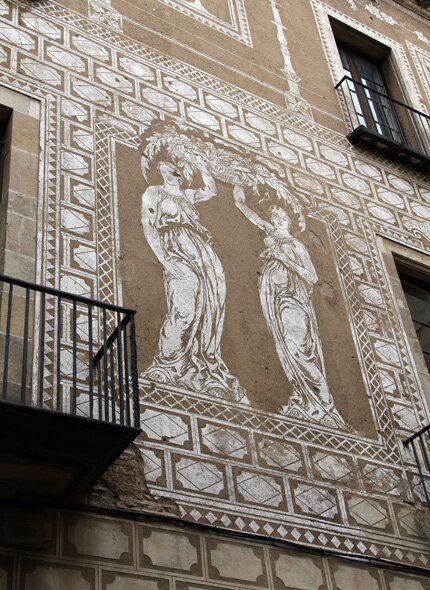
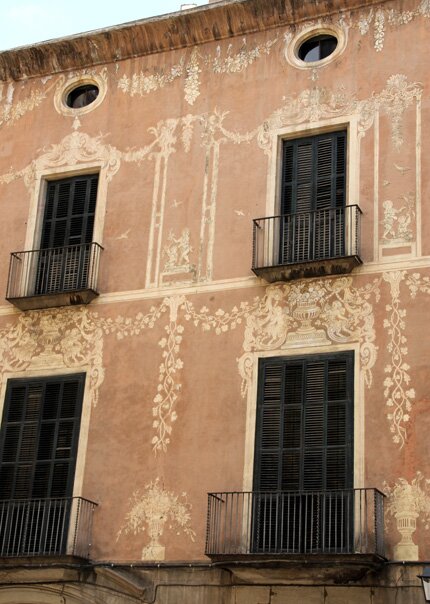
In Barcelona it was used quite a bit in the older Gothic Quarter.
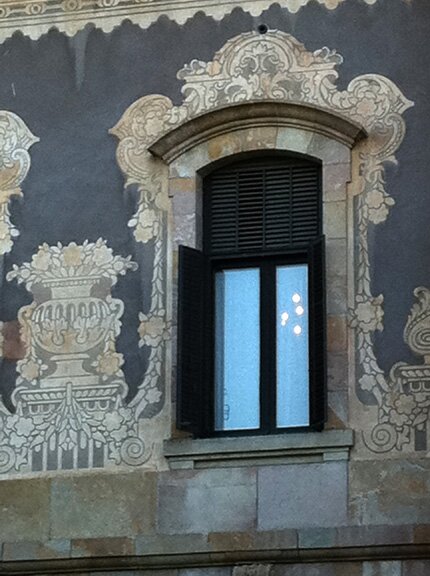
Alas, this labor intensive means of decoration has become something of a lost art.
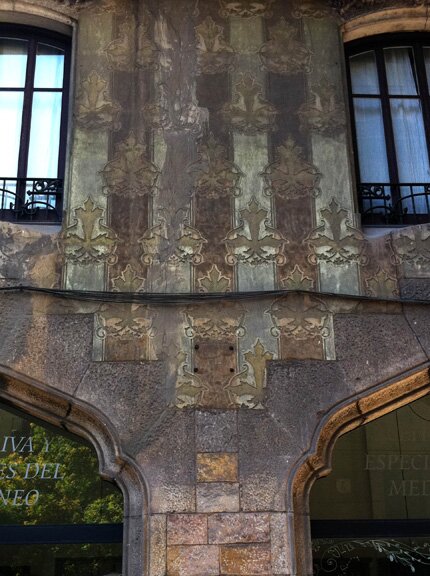
The common use of sgraffito may have had its last swan song at the beginning of the 20th century in the Eixample district of Barcelona, as they were constructing the beautifully detailed buildings that grace this area.
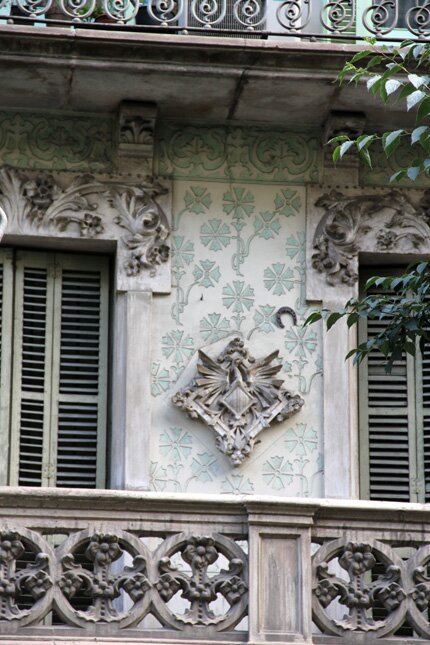
According to our guide on a recent tour there, at that time time labor was cheap and highly skilled craftsman were plentiful, so sgraffito was a “cheap” alternative to more expensive stone facades.
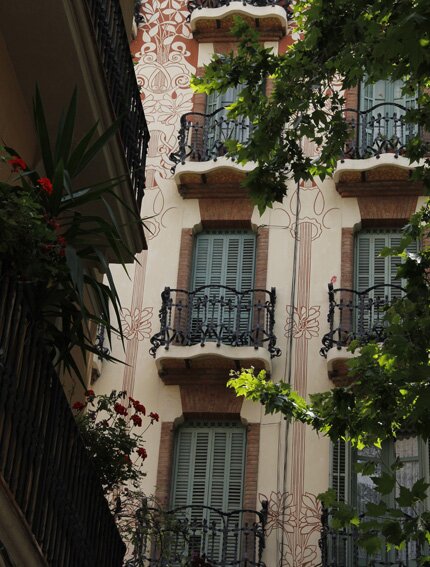
We can be thankful for this today, as the Modernisme movement of Catalunya has left us this gift in the city of Barcelona.
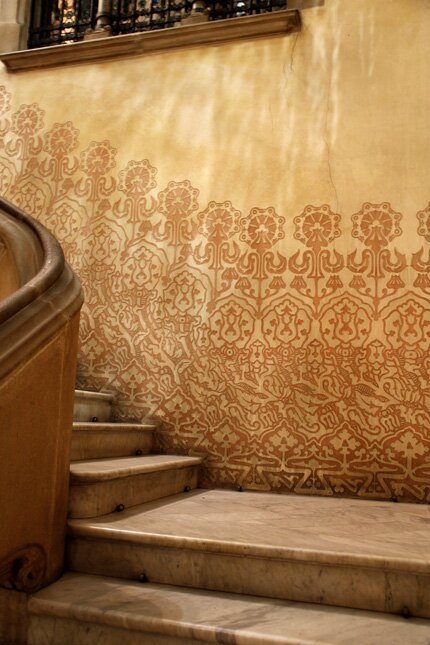
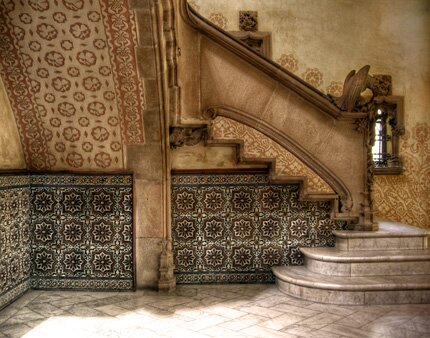
Some of the most stunning examples of Sgraffito can be found at Casa Amatllar, on the “Block of Discord”, right next to Gaudi’s Casa Batlló. This beautiful space, built by architect Puig i Cadafalch has just recently been opened to the public for tours. The photos above show just the open entrance area that anyone can walk into from the street. I unfortunately MISSED the opening time for the tour, but two of the ladies on our group were lucky enough to join a guided tour of the building and IT IS AMAZING with all the walls and ceilings FULL of decorative sgraffito (they sneaked some pics!). They will be closing it down again in a couple of months for a full renovation, but I can guarantee that this is the first place I will try to visit when I return to Barcelona!
Last image via flickr
July 5th, 2011
Painting at the Monestir
I have been super fortunate to have been given the opportunity to plan and lead painting adventures to many beautiful cities and countries of the world: France and Italy with my friend Gary Lord, and Marrakech with the help of Maryam Montague. These trips have now actually become an integral part of my business AND personal life. I love doing all the research and planning for both painting and enjoying the local culture, and most especially introducing new experiences to the students who sign on to these trips. With the help of my friend in Barcelona, Paul Deprez, I have just returned from a 2-week stay in Barcelona and the Catalunya region.
This was my fourth visit to Barcelona, and each time my love for this city grows exponentially. So much so that I am already planning a return painting trip for September 2012! But back to THIS trip….I have so much to share, but thought I should start with the primary reason *cough* for the tour-the decorative painting classes.
The trip was planned to include a 6 night stay in the city and 6 nights in a former monestary in the hills nearby.The monestir, Sant Jeroni de la Murtra, was partially burned and sacked in the 19th century during a widespread backlash against the corruption and power of the church. It is now run by a private foundation that maintains it as a place for solitude, silence, and encourages artistic pursuits.
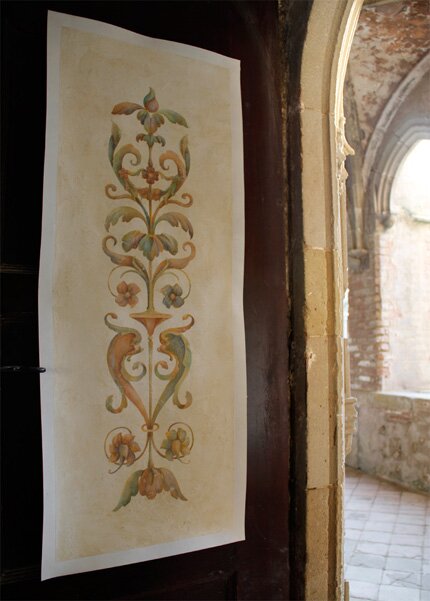
We were able to set up some small, low-ceilinged rooms as studio spaces to work on a range of projects. I wanted to take the opportunity to incorporate some forthcoming stencils from The Hearst Castle Collection, as these were designs created by Julia Morgan to decorate Hearst Castle in a Spanish/Mediterranean Revival style.
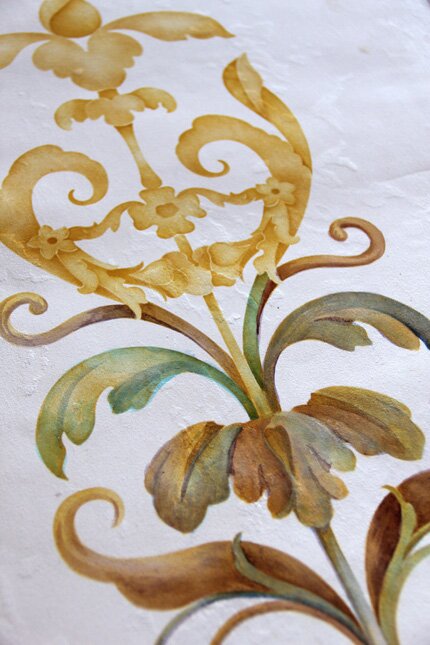
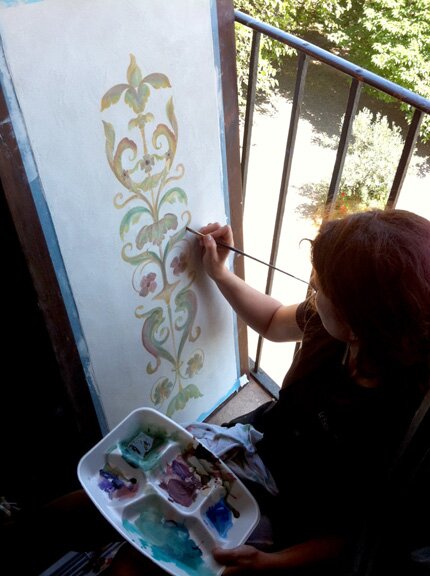
The Delphine Panel sample was done on smooth textured plaster background. We laid in the initial color and pattern with a simple dry-brush stencil technique. I was inspired by the amazing work of Italian artist, Carolina d’Ayala Valva, to overpaint the stenciling with washes of color to create a luminous look.
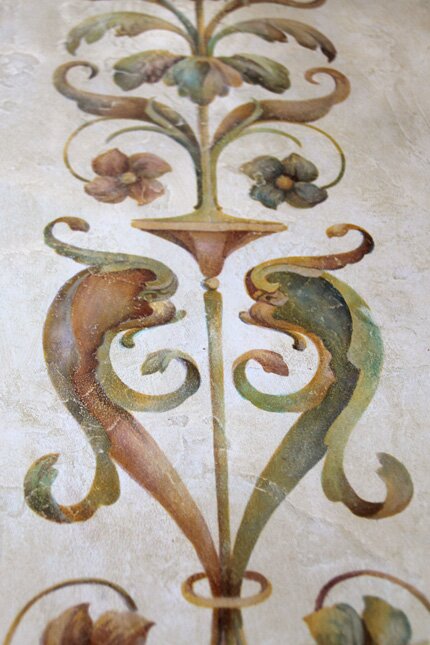
Some day, I would love to have the opportunity to study with Carolina in her Rome Atelier, but in the meantime I have her wonderful book, which I highly recommend! After painting with watered-down acrylics (as opposed to the traditional egg tempera) the painting on plaster was sanded to distress, and given a soft toning glaze.
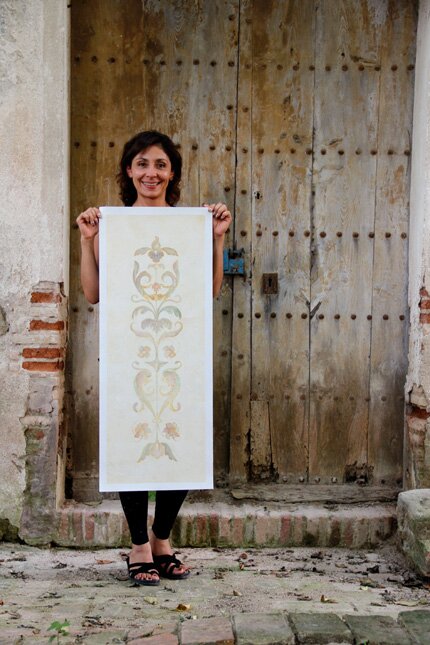
Here is lovely Nancy showing off her own completed panel.
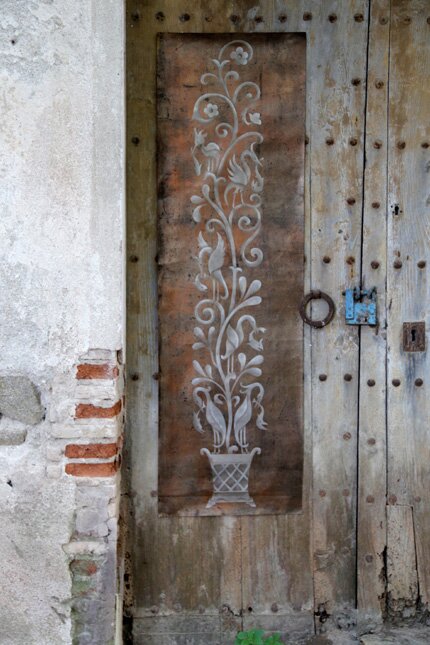
Another panel that I have taken from Julia Morgan’s amazing architectural drawings is the Pescado Panel. It is full of whimsical birds and fish that appear almost happy to have been caught-ha!
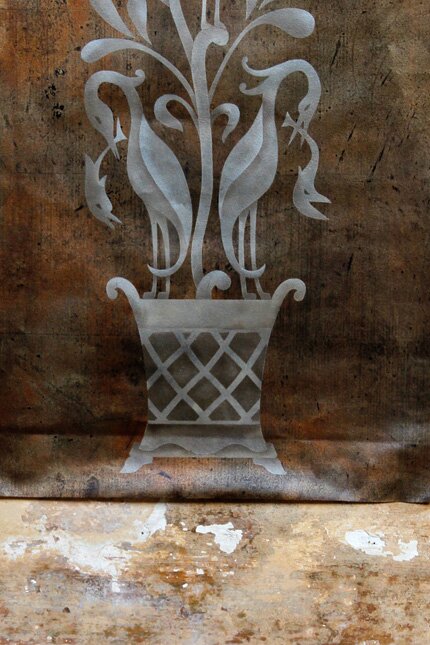
This panel is stenciled with three colors of our new Royal Stencil Cremes over a background of composition gold leaf. The gold leaf has been patinated and distressed with a safe chemical process that I am still perfecting-as much as you “can” perfect a chemical process! Once I have it a little more “under control”, I will surely share the details.
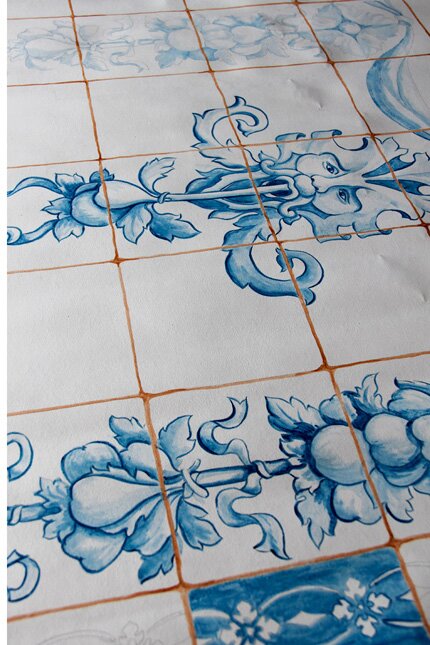
Another project that we worked on was a faux tile mural. For this we again used upcoming Hearst Castle Collection stencils. In this case we simply used them as patterns to trace and then add loose hand painting to create the look of classic Portuguese tiles. My sample above shows the mural in various stages of completion. I hope to finish the mural in the next couple of weeks. It was thrilling for me to have the time to actually pick up a brush and paint, as it seems my hands are most often attached to a computer keyboard these days!
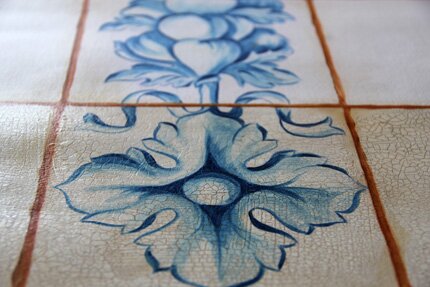
This study shows the final effect of the last step-adding a China Crackle layer (from Modern Masters) and rubbing in a toning glaze to reveal the cracks and add depth and aging.
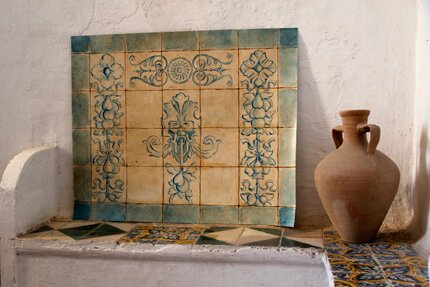
Here is a completed mural by Debbie Hayes, who was the fastest painter of the bunch of us! It’s quite beautiful, isn’t it? All of the stencils featured in the projects above will be available soon from Royal Design Studio stencils!
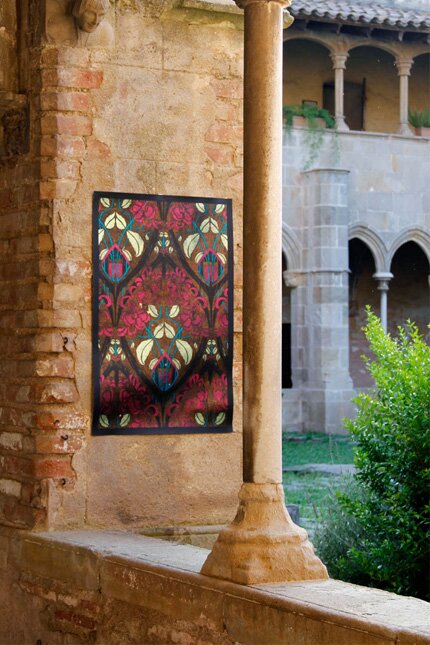
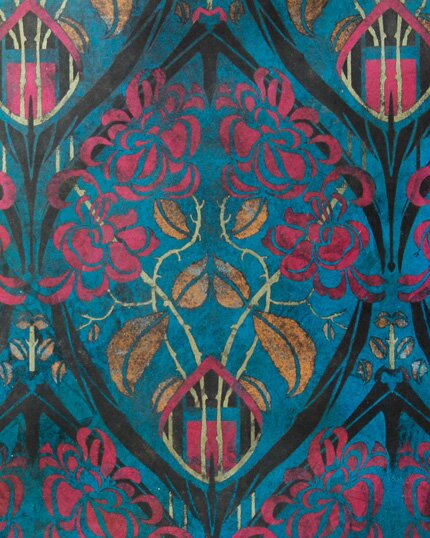
Another decorative style that is synonymous with Barcelona is Modernisme, the uniquely Catalunyan version of Art Nouveau. I wanted to honor that heritage, and so we also did a tecnique using metallic foils with a new Modello Marquetry Masking Pattern stencil from Modello Designs.
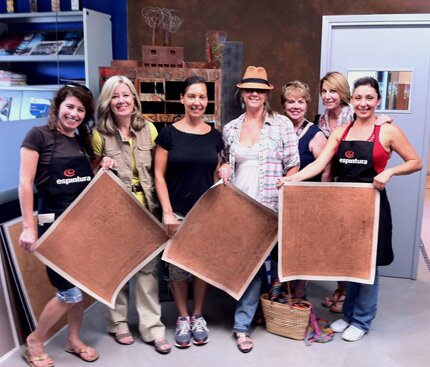
On our way from Barcelona to the monestir, we stopped at Espintura Studio to do an embedded tile pattern technique with SkimStone and a Modello masking pattern.
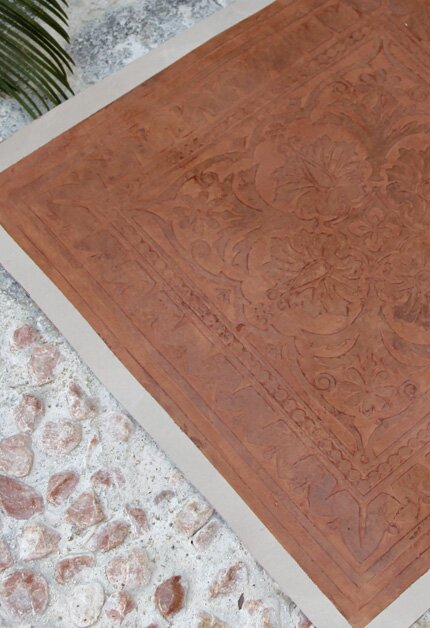
Now that I am back, I’m continuing to work on the videos and lessons for my next Virtual Workshop combining these two mediums.
I hope you enjoyed seeing our painting samples from Barcelona! As I said above, I am already planning a return trip in Sept. 2012, so drop me an email if you want to be the first to get those details when they become available!. The details on this recent trip are still available here.
You can view more photos from the Barcelona painting class and trip in my flickr sets!


 Copyright © Designamour